Why I Love Ravens: The Curious Observers of Our World

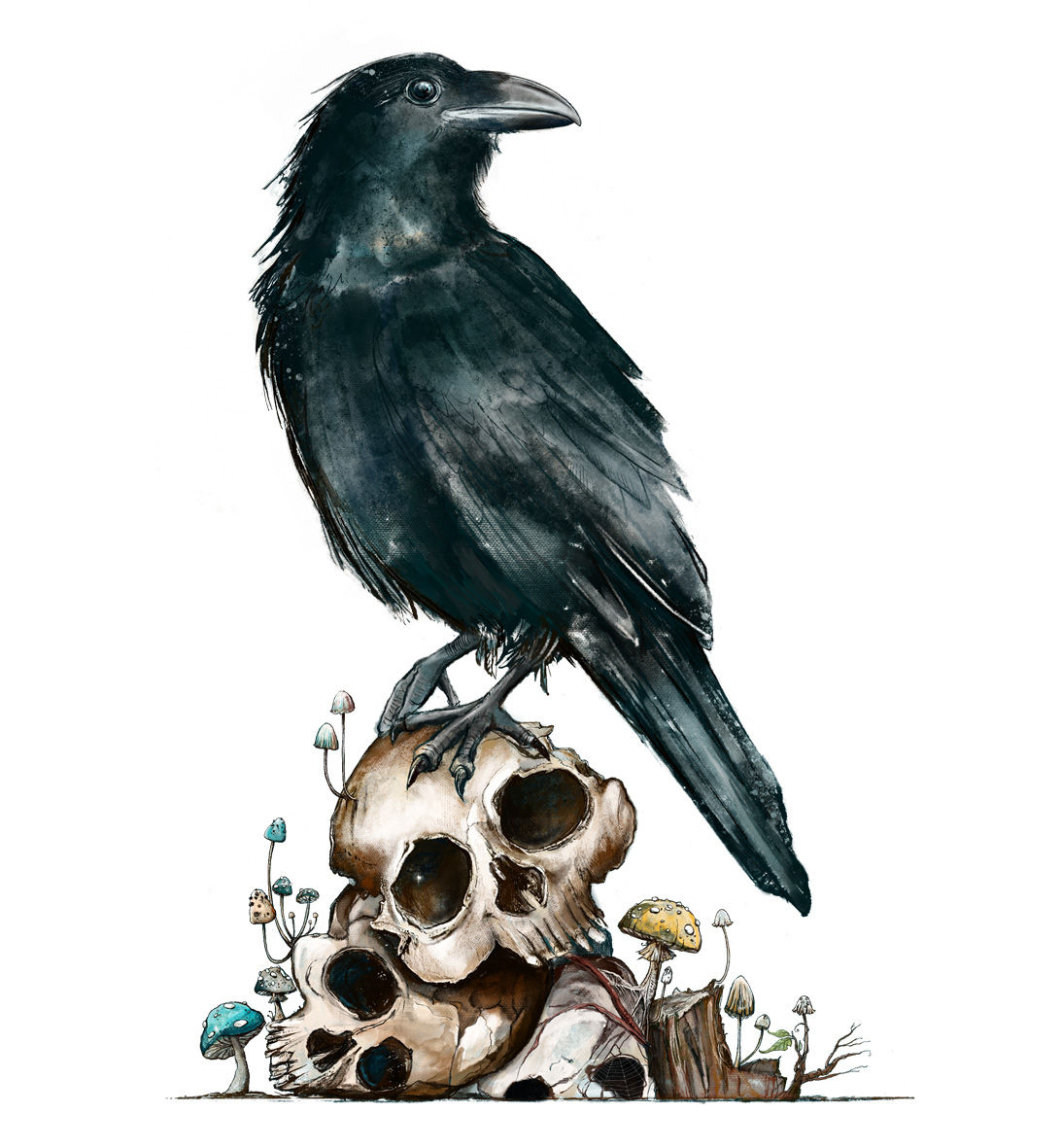


I sometimes think of ravens as life's observers. Wherever I go, there they are, watching the world go by from their own particular vantage point.
I see them flying overhead, perched on the soffits and cables when I'm outside, or hear their distinct sounds when I'm sitting in the studio! I've even had one investigating our beach bag (snack bag), successfully stealing a bag of smoky bacon crisps in the process! There's something rather wonderful about a bird that seems to be observing everything around it, quietly going about its business, until an opportunity presents itself.
Perhaps that's part of their appeal. Ravens seem to occupy that curious space between being part of the world and standing just slightly apart from it, watching everything unfold. Of course, we can't know exactly what they're thinking, but there's something about their watchful presence that makes you wonder.
A bird with a mind of its own
Part of my fascination with ravens (and corvids in general) comes from their intelligence. They're remarkably resourceful birds, capable of solving problems, learning from experience and adapting their behaviour to different situations.
Scientific research has shown that ravens can plan for certain future tasks, select objects for later use and demonstrate impressive flexibility in their behaviour. They're also highly social creatures, navigating relationships and competing for resources in ways that reveal just how complex their lives can be.
I find this endlessly fascinating. There's a sense of another mind at work, observing, assessing and making decisions. When a raven investigates a bag, works out how to get at some food or appears to be watching your every move, it's difficult not to be curious about what's going on behind those bright eyes.
And then, of course, there's the mischief. That stolen bag of crisps still makes me smile. Ravens might have a long history of being associated with wisdom and mystery, but they're also opportunists, perfectly capable of taking advantage of a moment of human distraction!
From the wild to the world of imagination
My fascination with ravens extends beyond the birds I encounter in everyday life. I'm also drawn to the way they've found their place in stories, mythology and fantasy.
One of my inspirations is Matthew, the raven from The Sandman graphic novels. I love the idea of a raven as a character in its own right, with personality, wit and a perspective on the world around it. Matthew is a wonderful example of how a bird can become so much more than a companion or a symbol. He is an individual.
Ravens have long occupied a special place in mythology and folklore, too. In Norse mythology, Odin's ravens, Huginn and Muninn, travel across the world and bring him information about what they've seen. Their names are commonly translated as Thought and Memory, which feels particularly fitting for birds so closely associated with observation and intelligence.
In Irish mythology, ravens are associated with the Morrígan, a figure connected with war, fate and sovereignty. Across different cultures and traditions, ravens have been linked with wisdom, prophecy, death and transformation.
Their dark plumage, striking appearance and remarkable behaviour have made them compelling figures in stories for centuries. Yet perhaps their real-life qualities are every bit as interesting as the mythology that surrounds them.
The artist's eye
I've always loved drawing birds. There's something about them that makes them endlessly fascinating to draw, the sweep and flow of their wings, the intensity of their eyes, the elegant shapes and the way their feathers fall. From owls and fantasy birds to blue tits, magpies and crows, my sketchbooks are full of them. Each has its own character and presence, and I never seem to tire of exploring them through illustration.


Ravens are particularly rewarding subjects. Their dark feathers might seem simple at first
glance, but there's so much to explore in their shapes, textures and subtle variations of light. Their silhouettes can be bold and dramatic, while the smallest details, the curve of a beak, the angle of a head or the glint in an eye, can give a drawing an entirely different personality.
I think that's what I love most about drawing birds: the challenge of capturing something of their character, rather than simply reproducing their appearance. A slight tilt of the head can suggest curiosity; the spread of a wing can convey movement and freedom. Even a bird sitting perfectly still can feel full of life.
And when a bird already carries so much meaning in our imagination, there's an added layer to explore. Ravens lend themselves naturally to darker, more mysterious imagery, but they can also be playful, curious and unexpectedly funny.
Why are we so fascinated by ravens?
Perhaps it's their intelligence. Perhaps it's their striking appearance, their place in folklore or the way they seem to belong equally to the ordinary world and the world of stories.
For me, it's probably a little of everything, and as I've mentioned it's not just the corvids that capture my imagination.
Daphne du Maurier’s 'The Birds And Other Short Stories' and Hitchcock’s iconic film adaptation cemented my love of the sinister side of our feathered friends. Who could forget that chilling scene of crows silently gathering on the school climbing frame, turning an ordinary playground into something deeply unsettling?
These days, living in Cornwall, it's the seagulls I'm keeping a close eye on. Or perhaps I should say they're keeping a close eye on me, or, more specifically, my pasty!

Explore the Indigo Alice shop to discover my raven-inspired artwork and other peculiar characters, magical places and dark little stories.
There's always room in the world for a little more raven magic.